
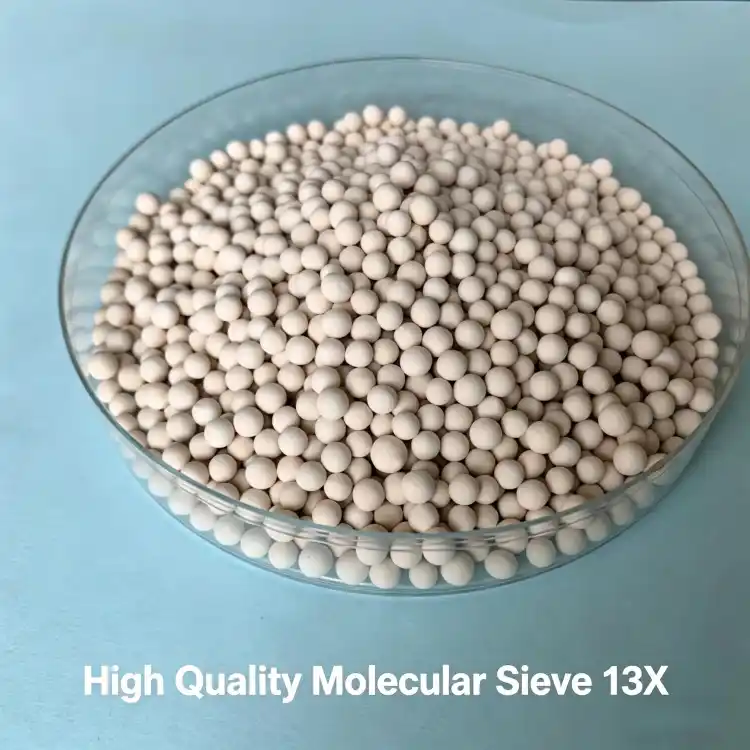
Top 6 Applications of Molecular Sieve 13X

Molecular sieve 13X is used when ordinary drying is not enough. Its large pore opening and strong affinity for polar molecules allow it to capture water, carbon dioxide, nitrogen and selected sulfur compounds from industrial gas and liquid streams.
That makes it useful in air separation, oxygen generation, natural gas treatment, hydrogen purification, carbon capture and refinery processing.
Table of Contents
What Is Molecular Sieve 13X?
13X is the sodium form of type X zeolite. Its effective pore opening is approximately 10 Å, or 1 nanometre. The larger pore structure allows it to take up molecules that cannot readily enter 3A, 4A or 5A zeolite pores.
Its common targets include:
- Water vapour
- Carbon dioxide
- Nitrogen
- Ammonia
- Alcohols and other oxygenates
- Selected sulfur compounds
- Some larger hydrocarbon impurities
13X as having one of the highest theoretical capacities among common molecular sieve adsorbents, along with good mass-transfer performance. It also confirms its ability to adsorb water, nitrogen, CO₂ and sulfur compounds. (Technical reference:https://zeochem.com/wp-content/uploads/2023/10/ZEOCHEM-Adsorbents-Brochure-r5a.pdf)
| Product information | Details |
|---|---|
| Product | Molecular Sieve 13X |
| CAS No. | 63231-69-6 |
| HS Code | 3824999999 |
| Available forms | Powder, extruded pellets and spherical beads |
| Approximate pore opening | 10 Å |
| Main functions | Dehydration, purification and gas separation |
1. Cryogenic Air Separation Pre-Purification
A cryogenic air separation unit cannot tolerate water or carbon dioxide entering the cold box. Both can freeze at low temperatures and restrict flow through heat exchangers and distillation equipment.
Molecular sieve 13X is installed in the air pre-purification unit to capture:
- Residual moisture
- Carbon dioxide
- Selected hydrocarbons
- Other trace contaminants
A typical system uses activated alumina in the first layer to handle the bulk water load, followed by 13X to remove CO₂ and the remaining moisture.
This helps prevent:
- Cold-box freeze-up
- CO₂ breakthrough
- Heat-exchanger blockage
- Rising differential pressure
- Shorter production cycles
- Unplanned ASU shutdowns
13X APG and other air-purification grades are widely used before cryogenic oxygen and nitrogen separation. Adsorption capacity, regeneration efficiency and bead strength all affect the length of the operating cycle.
2. PSA and VPSA Oxygen Generation
In PSA and VPSA oxygen plants, 13X selectively adsorbs nitrogen from compressed air. Oxygen is less strongly adsorbed and passes through the bed as the product stream.
The cycle follows a simple sequence:
- Compressed air enters the adsorber.
- Nitrogen is retained by the zeolite.
- Oxygen-enriched gas leaves the vessel.
- The bed is depressurised.
- Nitrogen is released.
- The adsorbent is ready for the next cycle.
This process is used in:
- Industrial oxygen generators
- Wastewater aeration
- Glass production
- Metal processing
- Aquaculture
- Ozone feed systems
- Central oxygen supply systems
Experimental adsorption data show that 13X takes up more nitrogen than oxygen under comparable test conditions, which supports its use in oxygen enrichment. (Research data:https://www.sciencedirect.com/science/article/pii/S2352340920305321)
Standard 13X can be used for PSA oxygen production. However, high-efficiency systems may use LiX, LiLSX or CaX grades with stronger nitrogen selectivity. The adsorbent should therefore be matched to the required oxygen output, pressure cycle and energy target.
3. Natural Gas and LNG Purification
Raw natural gas may contain water, CO₂, H₂S, COS, methanol, mercaptans and heavy hydrocarbons. These impurities can cause corrosion, hydrate formation, off-spec gas and problems in downstream low-temperature equipment.
Molecular sieve 13X can be used for:
- Deep natural gas dehydration
- CO₂ removal
- COS adsorption
- Trace contaminant polishing
- LNG and NGL feed preparation
- Light hydrocarbon gas treatment
Deep drying is especially important before LNG liquefaction and NGL recovery. Residual water can form ice or gas hydrates, while excess CO₂ can freeze inside the cryogenic section.
Feed contaminants also matter. Oil mist, BTX, compressor carryover and heavy hydrocarbons may occupy the pores, create a thermal tail during regeneration and shorten bed life.
4. PSA Hydrogen Purification
Crude hydrogen from steam methane reforming, refinery off-gas or chemical production may contain:
- Water
- Carbon dioxide
- Carbon monoxide
- Methane
- Nitrogen
- Light hydrocarbons
PSA hydrogen units use these differences in adsorption strength to separate hydrogen from the impurities. Hydrogen passes through the bed more easily, while stronger adsorbates remain on the molecular sieve and other bed materials.
13X is commonly used to capture water and CO₂ in a layered PSA system. Activated alumina, activated carbon, silica gel and other zeolites may be added to handle different contaminants.
Typical settings include:
- Refinery hydrogen recovery
- Steam reformer hydrogen purification
- Ammonia purge-gas recovery
- Methanol purge-gas treatment
- Petrochemical hydrogen systems
- Chemical synthesis gas purification
Good PSA performance depends on more than static adsorption capacity. Fast mass transfer, low attrition and consistent particle size help support short cycles without excessive pressure drop.
5. CO₂ Capture and Gas Upgrading
Zeolite 13X has a high affinity for carbon dioxide and is widely studied for PSA, VSA and TSA carbon capture.
Relevant duties include:
- CO₂ removal from natural gas
- Biogas upgrading
- Landfill-gas purification
- Flue-gas carbon capture
- Industrial gas polishing
- Feed preparation before cryogenic separation
In one published adsorption study, a 13X sample achieved a CO₂ equilibrium loading of approximately 3.755–4.857 mol/kg at a maximum CO₂ pressure of 1 bar. The tests were performed at 293, 313 and 333 K. (Research data: https://www.sciencedirect.com/science/article/pii/S2352340920305321)
This result shows the CO₂ affinity of 13X, but it should not be treated as the guaranteed working capacity of every commercial product. Dynamic capacity also depends on:
- Feed concentration
- Moisture level
- Adsorption temperature
- Operating pressure
- Cycle time
- Regeneration conditions
- Heat of adsorption
- Competitive adsorption
Water is particularly important because it binds strongly to 13X. A wet feed can take up a large part of the available capacity before CO₂ reaches the bed.
6. LPG, Refinery Gas and Mercaptan Removal
The large pores of 13X allow it to adsorb selected sulfur compounds and larger impurities. It can be used in LPG, refinery gas and light hydrocarbon purification systems.
Common duties include:
- Heavy mercaptan removal
- LPG sweetening support
- Refinery gas drying
- Light hydrocarbon purification
- Aerosol-grade LPG treatment
- Petrochemical feed polishing
This competition may lead to:
- Early mercaptan breakthrough
- Higher regeneration duty
- Carbon deposits
- Reduced working capacity
- Hot spots during regeneration
- Shorter adsorbent life
A complete hydrocarbon and sulfur analysis is therefore needed before the bed is designed.
Six Uses at a Glance
| Industrial use | Main adsorbates | Process value |
|---|---|---|
| Cryogenic air pre-purification | H₂O, CO₂ and trace hydrocarbons | Protects the cold box from freezing and blockage |
| PSA/VPSA oxygen generation | N₂, H₂O and CO₂ | Produces an oxygen-enriched stream |
| Natural gas and LNG treatment | H₂O, CO₂, COS and selected impurities | Controls dew point and protects cryogenic equipment |
| PSA hydrogen purification | H₂O, CO₂ and other contaminants | Supports high-purity hydrogen recovery |
| CO₂ capture and gas upgrading | CO₂ | Improves methane-rich gas and supports carbon capture |
| LPG and refinery purification | Mercaptans, H₂O and selected hydrocarbons | Improves feed quality and protects downstream systems |
HONREL Molecular Sieve 13X Forms
HONREL supplies three physical forms:
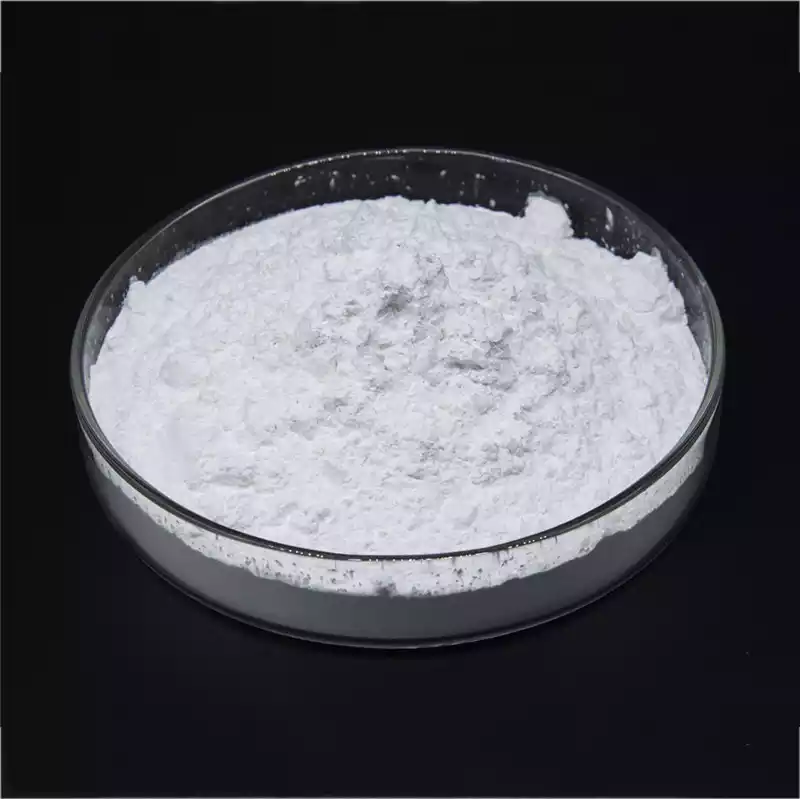
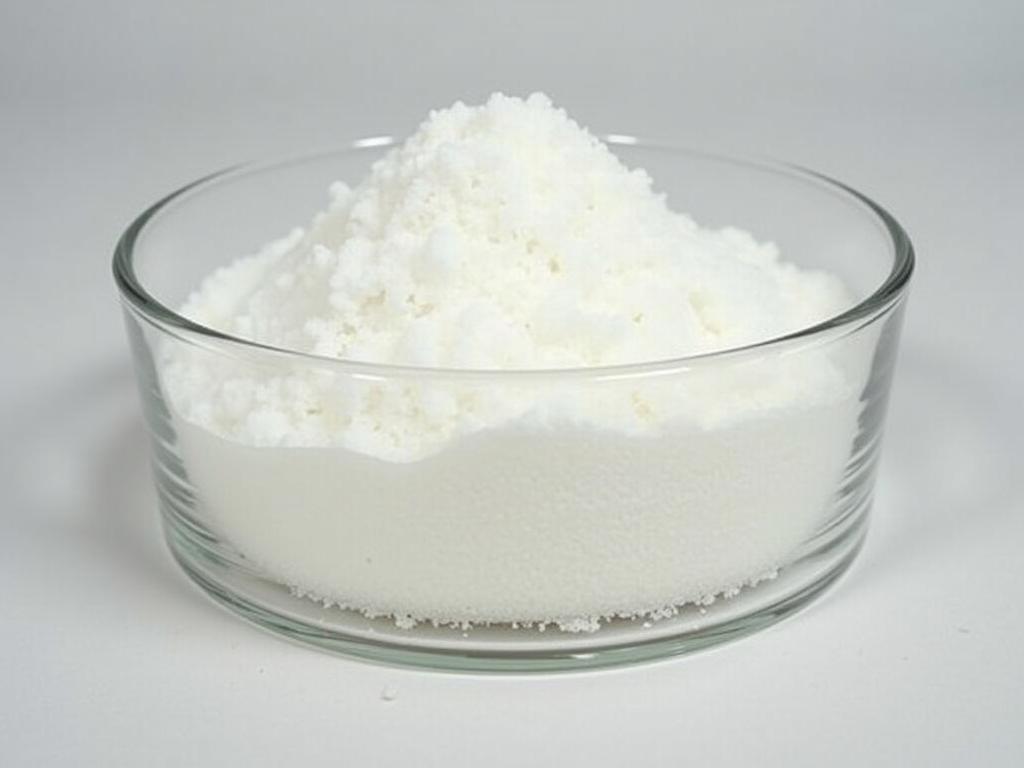
13X Molecular Sieve Powder
Powder is mainly used as a raw material for formulated adsorbents, catalysts and other industrial products. It is not normally loaded directly into a conventional fixed-bed vessel.
| Property | First-class product | Qualified product |
|---|---|---|
| Appearance | White powder, no mechanical impurities | White powder, no mechanical impurities |
| Static water adsorption | ≥32.5% | ≥32.0% |
| Static CO₂ adsorption at 0°C | ≥27.5% | ≥26.5% |
| Static CO₂ adsorption at 25°C | ≥23.5% | ≥22.5% |
| Packaged-product moisture | ≤22.5% | ≤23.0% |
| pH | ≤11.0 | ≤11.0 |
| Residue on 0.045 mm sieve | ≤0.5% | ≤0.5% |
| Tap density | ≥0.60 g/mL | ≥0.60 g/mL |
Static water adsorption is tested at 35°C ± 1°C and 75% relative humidity for 24 hours.
Extruded Molecular Sieve 13X
Extrudates are suitable for packed beds where low attrition, defined pressure drop and mechanical strength are required.
| Property | d 1.5–1.7 mm | d 3.0–3.3 mm |
|---|---|---|
| Static water adsorption, first class | ≥26.0% | ≥26.0% |
| Static water adsorption, qualified | ≥24.0% | ≥24.0% |
| Static CO₂ adsorption at 0°C, first class | ≥19.0% | ≥19.0% |
| Static CO₂ adsorption at 25°C, first class | ≥17.5% | ≥17.5% |
| Crushing strength, first class | ≥30 N/strip | ≥45 N/strip |
| Attrition rate, first class | ≤0.10% | ≤0.20% |
| Loose bulk density, first class | ≥0.61 g/mL | ≥0.61 g/mL |
| Packaged-product moisture | ≤1.5% | ≤1.5% |
Smaller extrudates provide a shorter diffusion path but may create a higher bed pressure drop. Larger pellets generally offer greater individual crushing strength and may be preferred in deeper or larger vessels.
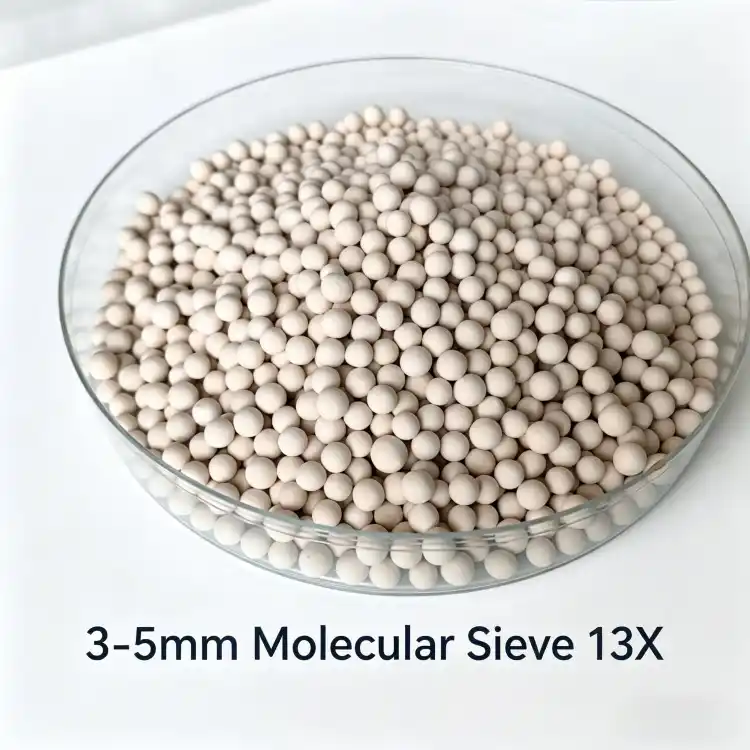
Spherical Molecular Sieve 13X
Spherical beads support uniform loading and are widely used in cyclic adsorption systems.
| Property | d 1.6–2.5 mm | d 3.0–5.0 mm |
|---|---|---|
| Static water adsorption, first class | ≥26.0% | ≥26.0% |
| Static water adsorption, qualified | ≥24.0% | ≥24.0% |
| Static CO₂ adsorption at 0°C, first class | ≥20.0% | ≥20.0% |
| Static CO₂ adsorption at 25°C, first class | ≥18.5% | ≥18.5% |
| Crushing strength, first class | ≥30 N/particle | ≥85 N/particle |
| Attrition rate, first class | ≤0.10% | ≤0.10% |
| Loose bulk density, first class | ≥0.64 g/mL | ≥0.64 g/mL |
| Particle-size compliance, first class | ≥98.0% | ≥98.0% |
| Packaged-product moisture | ≤1.5% | ≤1.5% |
What Matters in a Working Adsorber?
Static adsorption values are useful for quality control, but they do not fully predict plant performance.
An operating bed is also affected by:
- Dynamic working capacity
- Breakthrough time
- Gas velocity
- Mass-transfer zone length
- Inlet temperature
- Regeneration temperature
- Cooling efficiency
- Pressure drop
- Bed distribution
- Contaminant loading
- Pellet damage
A material with a high static CO₂ value may still deliver a short cycle if regeneration is incomplete or the feed contains water, oil or heavy hydrocarbons.
Choosing the Right Form and Size
Use powder when the material will be incorporated into another adsorbent or catalyst formulation.
Use smaller beads or extrudates when fast adsorption kinetics are important and the system can tolerate the additional pressure drop.
Use larger particles when the vessel is deep, gas flow is high or lower pressure drop and greater mechanical strength are priorities.
Before selecting a grade, provide:
- Feed composition
- Target contaminant
- Inlet concentration
- Required outlet specification
- Flow rate
- Pressure
- Adsorption temperature
- Regeneration method
- Cycle time
- Vessel dimensions
HONREL can then review whether 13X is suitable or whether another material from its catalyst raw materials range would better match the process.
Conclusion
The main uses of molecular sieve 13X are cryogenic air pre-purification, PSA oxygen generation, natural gas treatment, hydrogen purification, CO₂ capture and refinery or LPG cleanup.
Its 10 Å pore opening gives it broad adsorption capability, but successful operation depends on the feed, cycle design, regeneration and particle form. Powder, extrudates and spherical beads should not be treated as interchangeable products.
Browse the complete product range or contact the HONREL technical team to discuss adsorption targets, particle size, loading quantity and process conditions.