
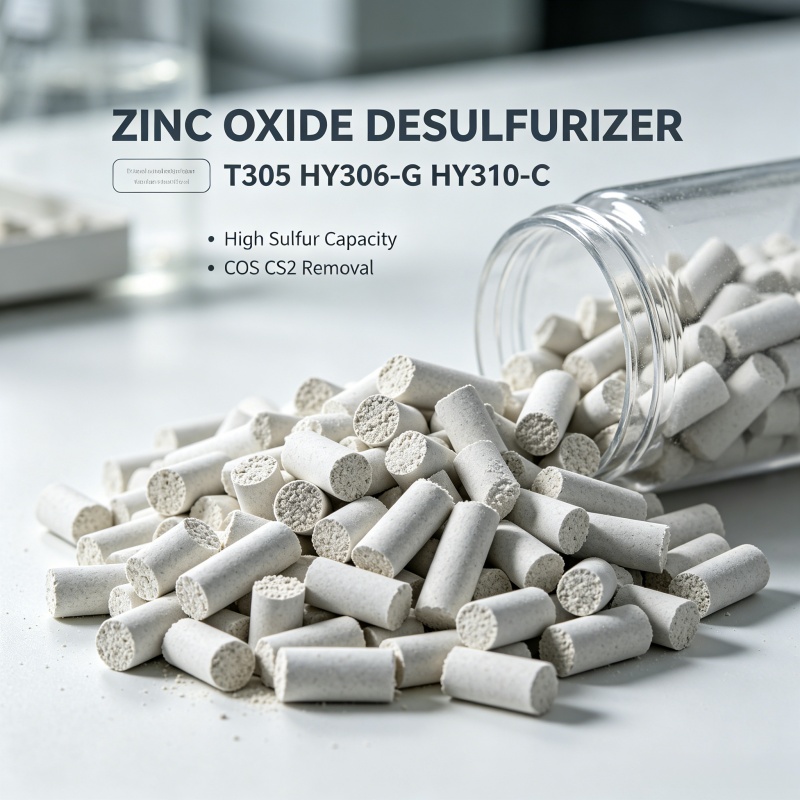
Zinc Oxide Desulfurization Catalyst Bed Life and Early Breakthrough

목차
What Does Early Breakthrough Mean?
Breakthrough begins when sulfur at the bed outlet approaches the maximum level allowed by the downstream process. The trigger should be the agreed outlet specification—not a fixed number of operating months.
One high analyzer reading is not enough to condemn the charge. Confirm the result with a repeat sample, check the analyzer and sampling line, then compare it with the inlet sulfur, flow, temperature and differential-pressure trends. This separates real bed exhaustion from an instrument or process upset.
| Outlet pattern | What it usually suggests |
|---|---|
| Slow, steady H2S rise near the expected run length | Normal movement of the mass-transfer zone toward the outlet |
| Sudden H2S jump after a feed change | Sulfur spike, higher flow or loss of upstream treatment |
| H2S slip immediately after loading | Channeling, bypass, incorrect loading or insufficient bed volume |
| H2S varies with temperature or throughput | Reaction-rate or contact-time limitation |
| Total sulfur rises while H2S remains controlled | Incomplete conversion or removal of organic sulfur |
| H2S rise occurs with increasing pressure drop | Fines, fouling, liquid carryover or bed compaction |
How to Estimate Zinc Oxide Desulfurization Catalyst Bed Life
Although the industry often calls it a catalyst, the ZnO charge is mainly a consumable reactive sorbent in this duty. Zinc oxide reacts with H2S to form zinc sulfide and water, so every sulfur pickup uses part of the bed’s finite inventory.
Bed life starts with a sulfur mass balance:
Usable sulfur inventory = loaded ZnO material × breakthrough sulfur capacity
Estimated bed life = usable sulfur inventory ÷ average daily sulfur load

The calculation needs an engineering margin for feed spikes, maldistribution and the unused portion of the bed below the breakthrough front. Catalogue ZnO content alone cannot provide this answer.
Breakthrough sulfur capacity is more useful because it measures how much sulfur the material holds before the outlet limit is reached under stated test conditions. The test temperature must always travel with the capacity value. A result measured at an elevated temperature should not be used as the expected capacity in a near-ambient vessel.
Do not size the charge from an average H2S number if the feed regularly spikes. The peak sulfur load can move the reaction front much faster than the monthly average suggests.
Seven Causes of Early Sulfur Breakthrough
1. The Sulfur Load Is Higher Than the Design Basis
Higher H2S, higher gas flow or longer operating hours all consume the bed faster. A change in the gas source can also introduce more COS or mercaptans even when H2S appears stable.
Compare the current sulfur mass flow with the original design case. If the present load is higher, the shortened cycle may reflect normal ZnO consumption rather than zinc oxide desulfurization catalyst decay.
2. The Grade Does Not Match the Real Temperature
Temperature affects reaction rate, diffusion through the pellet and usable sulfur capacity. There is no universal minimum temperature for every ZnO formulation.
HONREL HY310-C is designed for low- and normal-temperature service from 0–150°C. T305 covers 150–400°C, while HY306-G covers 150–450°C. The choice should be based on the vessel’s minimum, normal and maximum inlet temperature—not only its design value.
A conventional elevated-temperature material used in a cool bed may show low sulfur utilization. A grade that fits the actual window can improve the zinc oxide desulfurization catalyst lifecycle without changing the vessel.
3. Space Velocity Is Too High
When flow rises without additional bed volume, gas hourly space velocity increases and contact time falls. The mass-transfer zone becomes harder to contain inside the available bed, so H2S can appear at the outlet while unused ZnO remains deeper inside individual pellets or in poorly contacted areas.
Check actual flow, not only nameplate throughput. Also confirm whether the loaded volume and bulk density match the design calculation.
4. Loading Has Created Channeling or Bypass
Uneven filling, segregation, voids around vessel internals or a damaged support screen can give gas a low-resistance route through the bed. Part of the material then does little work while a narrow path reaches saturation early.
If breakthrough occurs soon after a fresh loading, review the loading record, final bed level, distributor, support grid and hold-down arrangement before blaming product quality.
5. Dust, Oil or Condensed Liquid Has Blocked the Pores
ZnO needs accessible pores so H2S can reach active material inside the pellet. Dust, compressor oil, tar and condensed hydrocarbons can seal the pore entrances. The result looks like zinc oxide desulfurization catalyst loss because part of the chemical capacity remains inaccessible.
Check upstream filters, separators, heat tracing and dew-point margin. Liquid carryover is more important than making a general claim that all water vapor poisons ZnO.
6. Pellets Have Broken Down
Poor handling, uncontrolled loading or weak material can create fines. Fines raise differential pressure, disturb gas distribution and increase the risk of channeling. A high ZnO percentage does not compensate for inadequate crush strength or abrasion resistance.
Trend differential pressure from startup. A rising value, together with early H2S slip, points toward a physical bed problem rather than simple chemical saturation.
7. Upstream Organic Sulfur Conversion Is Underperforming
Many natural gas and hydrogen units hydrogenate organic sulfur upstream and then capture the resulting H2S in the ZnO bed. If the hydrogenation catalyst, temperature or hydrogen supply is inadequate, mercaptans or thiophenic sulfur may pass forward.
Some promoted ZnO formulations can convert or absorb COS and CS2 under suitable conditions, but standard ZnO should not be expected to remove every organic sulfur compound. Test H2S and total sulfur separately. Otherwise an organic-sulfur slip may be mistaken for an exhausted H2S bed.
Bed Exhaustion or Operating Problem?
Before scheduling an emergency changeout, use the evidence together:
| 확인하다 | Normal exhaustion | Operating or mechanical problem |
|---|---|---|
| Outlet H2S trend | Gradual rise near expected end of run | Sudden, unstable or linked to a process change |
| Inlet sulfur load | Close to design basis | Higher concentration, flow or organic sulfur load |
| Differential pressure | Generally stable | Rising, fluctuating or abnormally low |
| 온도 | Inside the grade’s working window | Cold operation, hot spot or unstable profile |
| Spent material | Fairly even sulfiding through the bed | Fines, caking, discoloration or uneven reaction front |
| Post-changeout result | New charge restores the expected cycle | Early slip returns because the root cause remains |
Sampling spent material from the top, middle and bottom of the bed can be useful. An uneven sulfur profile may reveal channeling, maldistribution or an unexpectedly short mass-transfer zone. Do not mix the samples if the purpose is to understand the reaction front.
Which HONREL Grade Should You Review?
HONREL offers three starting points for fixed-bed H2S removal:
| 등급 | Operating range | Purchasing focus |
|---|---|---|
| HY310-C | 0–150°C | Low- and normal-temperature fine desulfurization |
| 티305 | 150~400°C | Standard elevated-temperature service |
| HY306-G | 150~450°C | High-temperature duty where higher usable sulfur capacity is required |
HONREL publishes breakthrough sulfur capacity of at least 10 wt% at 30°C for HY310-C, at least 20 wt% for T305, and at least 20 wt% at 220°C or 30 wt% at 350°C for HY306-G. These are grade-specific values under stated conditions, not universal guarantees for every gas stream.
전체 내용을 보려면 클릭하세요. HONREL catalyst range or read our zinc oxide desulfurizer replacement guide when comparing an incumbent product with a HONREL grade. For other suitable process duties, see zinc oxide desulfurizer applications.
What to Send HONREL for a Replacement Recommendation
The quickest route to a useful proposal is an operating-data package, not a request for “high-purity ZnO”. Send:
- Current product TDS, pellet size and manufacturer
- Vessel diameter, bed height, bed volume and loaded quantity
- Full gas composition and sulfur speciation
- Minimum, normal and maximum gas flow
- Inlet and outlet H2S trends
- Required sulfur limit at the outlet
- Temperature and pressure history
- Differential-pressure trend
- Current run length and the previous expected cycle
- Notes on sulfur spikes, liquid carryover or upstream unit faults
- Required quantity, destination and delivery schedule
If available, include photos and separate top-, middle- and bottom-bed analyses from the spent charge. These details help distinguish material exhaustion from poor distribution or contamination.
Replace the Cause, Not Just the Material
Early breakthrough is not always proof of a bad desulfurizer. It is proof that the complete bed duty needs to be checked.
HONREL can compare your sulfur load, temperature, GHSV, existing vessel and target run length with HY310-C, T305 or HY306-G. If a different grade or loading quantity is needed, we will explain the basis. If the data point to channeling or upstream contamination, that should be corrected before a new charge is installed.
Contact HONREL with your current TDS and operating history. The goal is not simply to refill the vessel. It is to restore a predictable sulfur-guard cycle and protect the downstream catalyst.