

Applications of Zinc Oxide Desulfurizers in Industrial Gas Purification

Sulfur in an industrial gas stream is rarely just a product-quality issue. Hydrogen sulfide can corrode equipment, increase maintenance work and poison downstream catalysts used in hydrogen, ammonia, methanol and petrochemical production.
A zinc oxide desulfurizer is commonly installed as a final sulfur guard when a process requires deep H₂S removal. It works across natural gas, syngas, coke oven gas, refinery gas and liquid hydrocarbon purification systems.
HONREL supplies several zinc oxide grades for normal-temperature and high-temperature service. The correct grade depends on the gas composition, operating temperature, pressure, space velocity and required outlet sulfur level.
Table of Contents
How Does a Zinc Oxide Desulfurizer Work?
Zinc oxide removes hydrogen sulfide through a gas-solid reaction:

During this reaction, zinc oxide is converted into stable zinc sulfide. For this reason, ZnO is more accurately described as a reactive adsorbent or sulfur sorbent, although the term “zinc oxide catalyst” is also widely used in industry.
The reaction has favourable sulfidation thermodynamics. A technical review published in Catalysts reports that ZnO can reduce H₂S to fractions of 1 ppm under suitable conditions. This makes it useful for polishing duties where downstream catalysts have a low tolerance for sulfur. However, real performance depends on temperature, gas composition, pore structure and mass transfer through the pellets. (Source:https://www.mdpi.com/2073-4344/10/5/521)
Zinc oxide can also assist with the conversion or capture of simpler organic sulfur compounds, including carbonyl sulfide and carbon disulfide:

Organic sulfur removal depends on the compound, temperature, hydrogen content and upstream process design. A gas analysis is therefore needed before sizing the guard bed.
Why Is ZnO Used for Deep Desulfurization?
Bulk sulfur removal and final polishing are different jobs. A high-H₂S stream may first need an amine unit, iron-based medium or another primary treatment stage. The zinc oxide bed is then used to catch residual sulfur before the clean gas reaches a sensitive process.
This arrangement provides several operational benefits:
- Low H₂S concentration at the bed outlet
- Protection against catalyst poisoning
- Longer downstream catalyst cycles
- Stable product quality
- Less unplanned shutdown work
- Simple fixed-bed operation
- No liquid absorbent circulation
- Compatibility with a wide range of pressures and temperatures
The commercial value is straightforward: replacing a sulfur guard on schedule is usually less disruptive than dealing with early deactivation of a reforming, methanol synthesis or ammonia process catalyst.
Main Industrial Uses
Natural Gas Purification
Natural gas can contain H₂S, COS, mercaptans and other sulfur compounds. After bulk acid-gas removal or sulfur hydrogenation, a ZnO guard bed can provide the final cleanup required before steam reforming or chemical synthesis.
The main goals are to:
- Meet the downstream sulfur specification
- Reduce corrosion risk
- Protect nickel-based reforming catalysts
- Maintain stable reformer performance
ZnO is also used as a pretreatment step before methane reforming because sulfur can poison the reforming catalyst.
Hydrogen Production
In conventional hydrogen plants, hydrocarbon feed is commonly desulfurized before entering the steam reformer. Sulfur slip can reduce catalyst activity, disturb temperature profiles and shorten the catalyst run length.
The ZnO vessel therefore acts as a guard bed between sulfur conversion and reforming. The key operating target is not simply a high removal percentage. It is a consistently low sulfur concentration at the outlet.
Ammonia Production
Natural gas, coal-derived syngas and other ammonia feedstocks must be cleaned before reforming, shift conversion and ammonia synthesis.
Zinc oxide is used for fine sulfur removal because it can capture residual H₂S that would otherwise affect downstream catalysts. Stable sulfur pickup helps plants extend operating cycles and reduce the risk of premature catalyst changeout.
Methanol and Syngas Purification
Copper-based methanol synthesis catalysts are sensitive to sulfur. A small amount of sulfur breakthrough can affect activity and plant output.
A ZnO sulfur guard can be placed in the feed purification train to remove H₂S and help manage COS after suitable upstream conversion. Research on biomass syngas also identifies ZnO guard beds as a practical polishing stage for deep desulfurization. (Sourc:https://pubs.acs.org/doi/10.1021/acs.energyfuels.9b04276)
Typical duties include:
- Coal-derived syngas cleanup
- Biomass syngas polishing
- Methanol feed purification
- Fischer–Tropsch feed protection
- Hydrogen-rich process gas treatment
Coke Oven Gas and Coal Gas
Coke oven gas and coal gas may contain H₂S, COS, tar traces, moisture and other contaminants. Upstream removal of particulates and condensable compounds is important because fouling can block the ZnO pellet pores and increase bed pressure drop.
Once the gas is properly conditioned, zinc oxide can be used as the final polishing medium before chemical synthesis, fuel use or another catalytic step.
Petroleum Refining and Liquid Hydrocarbons
Refinery gas, light hydrocarbons, naphtha and related streams may require sulfur removal before reforming, hydrogenation, polymerisation or other catalytic operations.
ZnO grades can be used to capture H₂S formed during upstream hydrodesulfurization. Depending on the formulation and process conditions, they may also convert or absorb limited amounts of COS, CS₂ and other simple sulfur compounds.
Biogas and Fuel Gas
Biogas can contain H₂S at levels that cause corrosion, odour and damage to engines, fuel cells or reforming equipment.
ZnO may be used as a polishing medium after primary biogas treatment. For near-ambient service, a low-temperature grade should be selected because conventional ZnO materials often deliver better sulfur utilisation at elevated temperatures.
Temperature Matters
A zinc oxide bed should not be selected by ZnO percentage alone. Temperature has a direct effect on reaction rate, sulfur pickup and bed life.
| Service range | Typical consideration |
|---|---|
| 0–150°C | Requires a grade designed for normal or low-temperature operation |
| 150–300°C | Suitable for many gas-polishing duties, subject to feed composition |
| 300–400°C | Common range for high-temperature ZnO sulfur guards |
| Above 400°C | Material stability and reducing conditions need closer review |
Research shows that high surface area and accessible pore volume can improve sulfur capture. However, very high temperatures may cause pore damage, sintering or ZnO reduction in strongly reducing gas. Above approximately 600°C, elemental zinc formation and volatilisation become a concern. (Source: https://www.mdpi.com/2073-4344/10/5/521)
HONREL Zinc Oxide Desulfurizer Grades
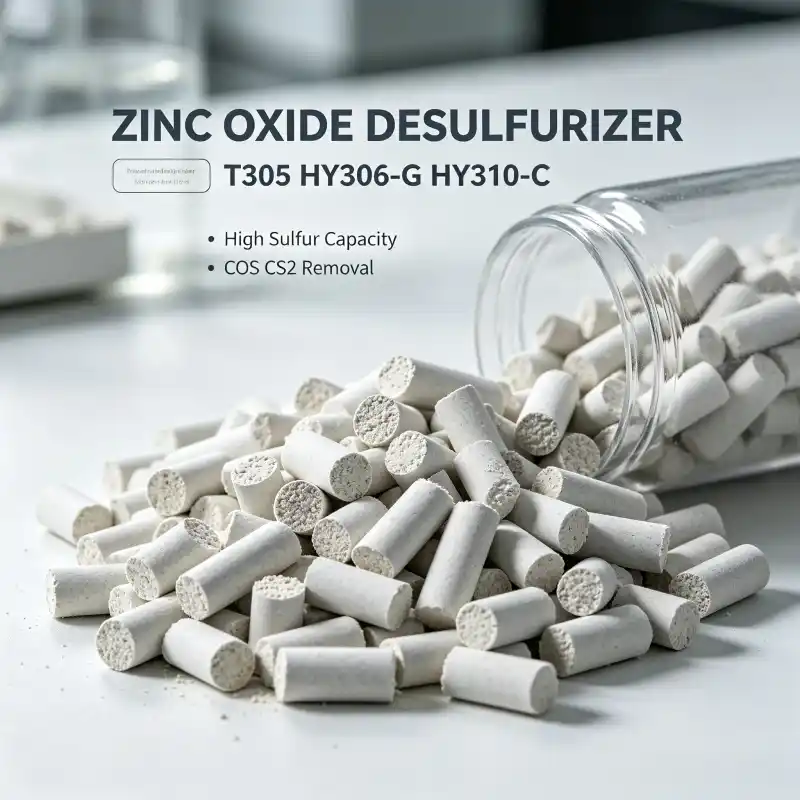
The HONREL Zinc Oxide Desulfurizer series contains three grades:
- HY306-G: high-temperature service
- HY310-C: normal and low-temperature service
- T305: standard elevated-temperature service
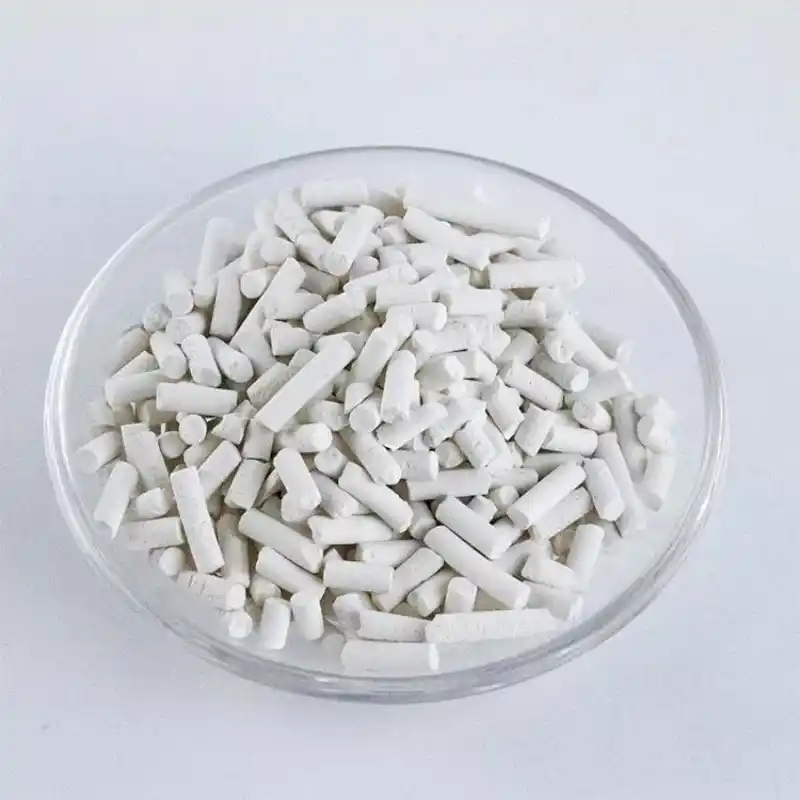
Active ZnO is combined with selected components and formed into light-yellow or white extrudates. The grades are intended for fine desulfurization in natural gas, ammonia, hydrogen, petroleum refining, syngas and liquid hydrocarbon systems.
Product Specifications
| Property | Unit | HY306-G | HY310-C | T305 |
|---|---|---|---|---|
| Appearance | — | Light-yellow or white strips | Light-yellow or white strips | Light-yellow or white strips |
| Size | mm | φ3–5 × 5–15 | φ3–5 × 5–10 | φ3–5 × 5–15 |
| Density | kg/L | 1.0 ± 0.2 | 1.0 ± 0.2 | 1.0 ± 0.1 |
| Lateral compressive strength | N/cm | ≥60 | ≥60 | ≥40 |
| Abrasion rate | % | ≤5.0 | ≤5.0 | ≤6.0 |
| Breakthrough sulfur capacity | wt% | ≥20 at 220°C; ≥30 at 350°C | ≥10 at 30°C | ≥20 |
| ZnO and active components | % | ≥95 | ≥90 | ZnO ≥95 |
Applicable Process Conditions
| Condition | Unit | HY306-G | HY310-C | T305 |
|---|---|---|---|---|
| Pressure | MPa | 0–6.0 | <8.0 | 0–6.0 |
| Operating temperature | °C | 150–450 | 0–150 | 150–400 |
| Preferred temperature | °C | 300–400 | Process-dependent | 300–400 |
| Space velocity | h⁻¹ | 1,000–3,000 | 1,000–3,000 | 1,000–3,000 |
| H₂S at outlet | ppm | <0.1 | <0.1 | <0.1 |
| Oxygen content | % | <0.5 | <0.5 | <0.5 |
The recommended space velocity may be increased as the inlet H₂S concentration falls. Final loading and operating conditions should be confirmed against the complete feed-gas analysis.
What Controls Bed Performance?
Inlet Sulfur Loading
A higher H₂S concentration consumes the active ZnO faster. Inlet sulfur loading, gas flow and required run length determine the amount of adsorbent needed.
Space Velocity
Excessive gas hourly space velocity reduces contact time and may bring forward the breakthrough point. A lower H₂S inlet level may allow a higher space velocity, but the full mass balance still needs to be checked.
Pellet Strength
Weak extrudates can break during loading or operation. Fines increase pressure drop, create channeling and reduce effective bed utilisation. Lateral compressive strength and abrasion rate therefore matter alongside chemical activity.
Pore Structure
The reaction begins at the pellet surface. As ZnS forms, H₂S must diffuse through the reacted layer to reach unused ZnO inside the pellet.
Poor pore accessibility can leave part of the ZnO unreacted even when sulfur appears at the vessel outlet. This is why breakthrough sulfur capacity is more useful than ZnO content alone.
Water, CO₂ and Oxygen
Water vapour, carbon dioxide and oxygen can change the behaviour of the bed. High-CO₂ streams need particular care because ZnCO₃ formation may block access to active ZnO under certain conditions.
HONREL specifies oxygen below 0.5% for these grades. Feed moisture, CO₂ concentration and steam-to-gas ratio should also be reviewed during grade selection.
Upstream Contaminants
Tar, oil mist, dust and condensable hydrocarbons may foul the bed. Effective separation and temperature control upstream help prevent blocked pores, rising differential pressure and early sulfur breakthrough.
Choosing the Right Grade
A useful enquiry should include more than the gas name. For reliable selection, provide:
- Complete gas composition
- Inlet H₂S concentration
- COS, CS₂ and mercaptan levels
- Required outlet sulfur
- Gas flow rate
- Operating pressure
- Minimum and maximum temperature
- CO₂, oxygen and moisture content
- Available vessel dimensions
- Target operating cycle
HY310-C is designed for normal and low-temperature duties. HY306-G and T305 cover elevated-temperature service, with preferred operating ranges around 300–400°C. The final choice should balance sulfur capacity, bed volume, mechanical strength, pressure drop and planned changeout interval.
Final Thoughts
Zinc oxide desulfurizers are widely used where low sulfur slip and dependable catalyst protection matter. Their main uses include natural gas treatment, hydrogen production, ammonia synthesis, methanol feed purification, petroleum refining, syngas polishing and liquid hydrocarbon cleanup.
Good results depend on matching the sorbent to the actual process. Temperature, sulfur loading, space velocity, gas composition and pellet strength all affect bed life and outlet quality.
Browse HONREL’s full range of industrial catalysts and purification materials or visit the product centre for other chemical processing solutions. To discuss grade selection, loading quantity or operating conditions, contact us.