
13X Molecular Sieve Regeneration Why Adsorption Capacity Falls

Regeneration should restore a molecular sieve bed. When outlet moisture or CO₂ starts breaking through earlier after every cycle, the adsorbent is often blamed first. That conclusion can be premature.
Poor heating, weak purge flow, incomplete depressurisation, inadequate cooling or a higher contaminant load can all reduce apparent working capacity. Oil contamination, hydrothermal damage and particle breakdown are harder to reverse.
The practical question is whether the 13X molecular sieve regeneration cycle is incomplete or the bed has reached the point where replacement makes more commercial sense.
목차
Confirm That Adsorption Capacity Has Really Fallen
Do not judge the bed from cycle time alone. Compare the current run with a healthy baseline under similar inlet conditions.
Check:
- inlet and outlet water, CO₂ or other target contaminants;
- gas flow, pressure and adsorption temperature;
- cycle length and switchover logic;
- regeneration-gas temperature, flow and pressure;
- heating, depressurisation, purge and cooling time;
- bed differential pressure; and
- analyser calibration and sample-line condition.
A warmer feed or higher inlet contaminant load shortens breakthrough time even when the 13X zeolite has not deteriorated. Higher gas velocity also gives the mass-transfer zone less time to move through the bed.
For an air-separation pre-purifier, trend water and CO₂ separately where possible. For PSA oxygen service, confirm whether the problem is nitrogen working capacity, residual moisture or a valve and cycle issue. These are different duties even when both use type 13X.
Incomplete Regeneration Leaves the Bed Partly Loaded
The heater outlet may reach its target while the cold end of the vessel remains below the required condition. If heating stops too early, water and CO₂ remain on the adsorbent. The next adsorption step then starts with part of the pore volume already occupied.
Four parameters should be reviewed together:
| Regeneration parameter | What can go wrong | Plant result |
|---|---|---|
| Temperature profile | The bed outlet never reaches the required condition | Residual adsorbate remains in the lower-temperature zone |
| Heating time | The thermal front does not pass through the full charge | Capacity falls progressively over several cycles |
| Purge flow or vacuum | Desorbed material is not removed from the vessel | High residual loading at the next adsorption step |
| 냉각 | The bed returns to service too warm or still contains wet regeneration gas | Lower initial capacity and earlier breakthrough |
Do not use one universal regeneration temperature for every molecular sieve 13X system. TSA, PSA and vacuum-regenerated units work differently. Gas composition, pressure, vessel design and adsorbent grade also change the correct procedure.
Excess Heat and Water Can Cause Permanent Ageing
More heat is not always better. Repeated exposure to high temperature in the presence of water can damage the binder and zeolite structure. Rapid heating and cooling can also increase mechanical stress.
Published work on temperature-swing adsorption(sciencedirect.com/science/article/pii/S1385894722045284) has shown that thermal and hydrothermal exposure can reduce the long-term capacity of zeolite 13X. Laboratory ageing data should not be converted directly into a plant-life guarantee, but the mechanism explains why an overheated wet bed may not recover after the regeneration programme is corrected.
Look at the temperature profile rather than only the maximum reading. Local hot spots can form when contaminated material is regenerated or when flow distribution is poor. A controlled ramp, adequate purge and complete cooling protect both capacity and mechanical condition.
Never raise regeneration temperature beyond the approved operating procedure in an attempt to burn off contamination. Hydrocarbons or oil inside a hot adsorber can create an unsafe exotherm.
Oil and Heavy Contaminants Block the Micropores
Water and CO₂ are normally removable under a suitable cycle. Compressor oil, heavy hydrocarbons, glycol, amine carryover and some process contaminants are much harder to desorb.
Oil aerosol can coat the external surface and enter larger transport pores. Heavy organics may remain after a normal regeneration step or decompose during heating. Both reduce access to the internal adsorption sites.
Dust, rust and desiccant fragments cause a different problem. They may not poison the zeolite crystal, but they can obstruct flow, plug support screens and promote channeling.
Operating Conditions Can Mimic Spent Adsorbent
Adsorption is sensitive to temperature and partial pressure. A higher inlet temperature usually lowers equilibrium loading. More water or CO₂ entering the vessel consumes working capacity faster. Shorter cycles, higher flow and incomplete pressure equalisation can produce the same symptom.
Before ordering a replacement, check for changes in:
- compressor discharge and aftercooler performance;
- separator and drain operation;
- feed composition and seasonal humidity;
- adsorption pressure and flow;
- valve timing, leakage and equalisation;
- regeneration-gas source and quality; and
- cooling-gas temperature.
An analyser placed downstream may also show apparent breakthrough because of sample-line moisture, valve leakage or calibration drift. Confirm the measurement before condemning the bed.
Readers working specifically with air-separation pre-purifiers can also review 13X molecular sieve bead size and CO₂ capacity. Particle size, mass-transfer rate and pressure drop must be assessed together.
Bed Damage Reduces Usable Capacity
A bed can contain chemically active material and still perform badly because the gas no longer contacts it evenly.
Rapid pressure changes, excessive gas velocity, poor hold-down, rough loading or damaged internals can move and abrade the particles. Fines accumulate in the voids, raising pressure drop. Local compaction creates high-resistance zones, while voids and settled areas create bypass paths.
| Bed evidence | Likely problem | Replacement implication |
|---|---|---|
| Rising normalised differential pressure | Fines, debris or screen restriction | Physical inspection and replacement may be required |
| Earlier breakthrough with normal ΔP | Incomplete regeneration, higher feed load or chemical ageing | Correct the cycle and verify feed before replacing |
| Uneven bed-temperature front | Channeling, poor distribution or local contamination | Inspect loading condition and internals |
| Dust downstream of the vessel | Attrition or screen damage | Check particle integrity and containment |
| Bed level has fallen | Settling, breakage or material loss | Confirm remaining volume and loading condition |
Adsorbent lost as fines cannot be restored by regeneration. If the support screen or gas distributor caused the damage, repair it before loading new material.
How to Specify a 13X Molecular Sieve Replacement
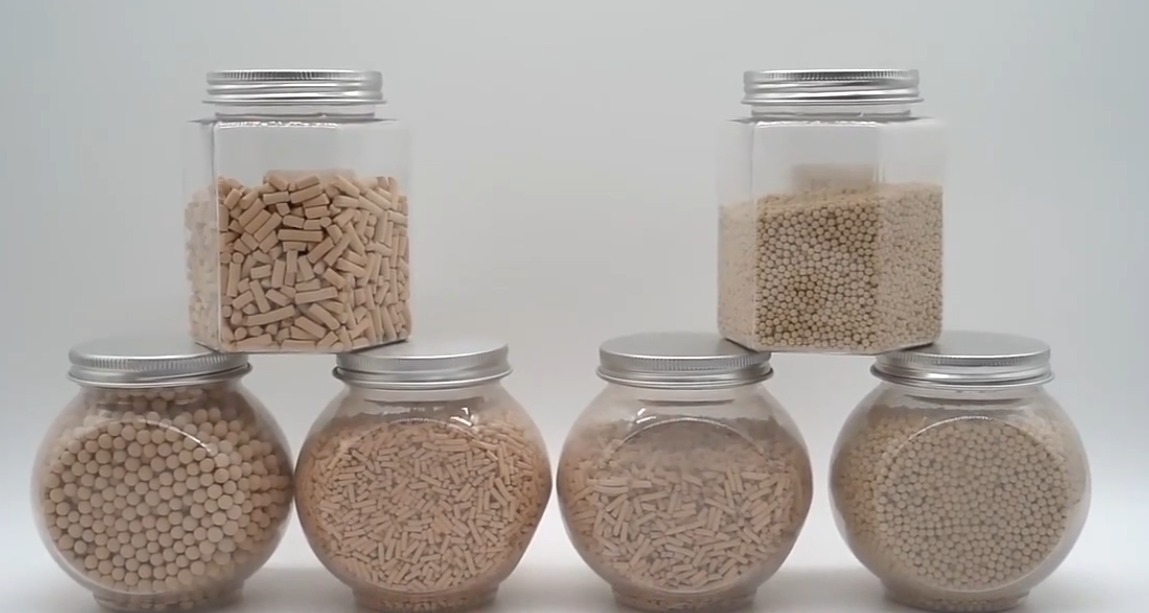
HONREL 공급품 13X Molecular Sieve as spherical beads, cylindrical extrudates and powder. Shaped products are available in multiple particle ranges for direct loading into industrial adsorption vessels.
When comparing molecular sieve suppliers, a product name alone is not enough. For a useful replacement quote, send:
| Information | 왜 중요한가 |
|---|---|
| Current grade, TDS and latest COA | Establishes the performance reference |
| Bead or extrudate size | Affects mass transfer, pressure drop and loading density |
| Vessel dimensions and usable bed volume | Supports quantity calculation |
| Previous loading weight and final bed height | Checks actual loaded bulk density |
| Target contaminants and feed composition | Identifies the adsorption duty |
| Flow, pressure and inlet temperature | Defines operating severity |
| 필수 콘센트 사양 | Confirms the purification target |
| Adsorption and regeneration cycle | Shows how the working capacity is used and restored |
| Current ΔP and breakthrough trend | Helps separate mechanical and capacity problems |
| Known oil, water or process upsets | Identifies contamination risk |
| Required quantity, destination and delivery date | Supports the quotation and supply plan |
Do not copy the previous order weight without checking the new product’s bulk density and particle form. The same vessel volume can require a different loading mass.
HONREL can compare the existing specification with its available 13X grades before quotation. For wider use cases, see 분자체 13X의 주요 응용 분야 6가지. Buyers comparing documentation, particle forms and supply options can also review HONREL’s 13X molecular sieve manufacturer page or browse the catalyst raw material range.
If regeneration no longer restores the required outlet quality, HONREL에 문의하세요 with the current product data sheet, bed volume, loading weight and operating history. This allows the team to recommend a compatible 13X molecular sieve desiccant instead of quoting a generic grade.